კოპირების სახარატო ჩარხი
A copy lathe repeats a turned profile: a stylus follows a master pattern while the cutter reproduces that shape on the blank, so the fiftieth table leg matches the first without measuring. This category holds 3 HOLZMANN copy lathes - the four-speed DBK1300, the stepless-drive DBK1300F and the long-bed DBK1500 - covering 1300 to 1500 mm between centres and 1100 to 1300 mm of copy length. Every machine is supplied by quotation, with the tooling, delivery and installation specified for your workshop. Choose first by the length of the longest part you repeat, then by whether four belt speeds or stepless speed control suits your blanks.
განახლდა
ნაპოვნი დანადგარები
-
HOLZMANN
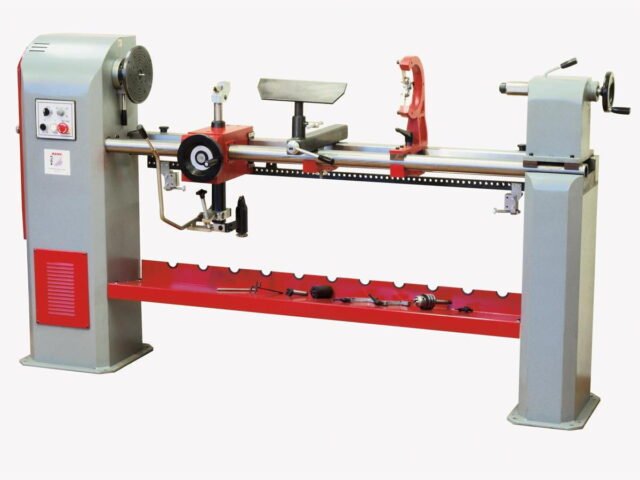
HOLZMANN DBK1300 Copy Wood Turning Lathe (1300 mm, 230 V / 400 V)
DBK1300- Motor power
- 1.5 kW
- Voltage
- 230V
ფასი მოთხოვნით ფასის მოთხოვნა
What a copy lathe does that a plain wood lathe cannot
A copy lathe repeats a profile without skill-dependent measuring. The copying carriage tracks a master pattern with a stylus while the cutter reproduces that profile on the blank, so a run of forty chair legs or a batch of stair balusters comes off the machine matching each other rather than matching the turner’s eye. A conventional wood lathe remains the better tool for bowls, hollow forms and one-off work; a copy lathe earns its place the moment the same spindle has to be made again and again. All three HOLZMANN DBK machines on this page are spindle copy lathes built around that carriage.
How to choose between the three DBK copy lathes
Start from the longest part you repeat, because capacity cannot be worked around. The DBK1300 and DBK1300F take 1300 mm between centres and copy a master up to 1100 mm long. The DBK1500 takes 1500 mm between centres and copies up to 1300 mm, which is the difference between a table leg and a stair newel. Buying the short bed for long work is the single most expensive mistake on this category.
Four belt speeds or stepless drive
Speed control is the second decision on a copy lathe. The DBK1300 and DBK1500 run four belt speeds of 2800, 1950, 1000 and 500 min-1, which is enough for prepared, reasonably balanced blanks. The DBK1300F replaces those steps with a stepless 0-3000 min-1 drive, so a heavy or out-of-balance blank can be wound up gradually instead of being started at a fixed speed. Workshops turning green or irregular stock feel that difference immediately.
Single-phase or three-phase supply
Mains supply narrows this category faster than any other criterion. The DBK1300 is the only HOLZMANN copy lathe here catalogued for single-phase, listed as DBK1300_230V beside DBK1300_400V, so a workshop with no three-phase connection is effectively choosing the 230 V DBK1300. The DBK1300F and DBK1500 are three-phase machines. Confirm what is actually available at the machine position before the quotation is prepared, because arranging a new supply changes both the installation work and the layout of the shop.
Floor space, extraction and the tooling you budget separately
A copy lathe needs length rather than width. Allow the bed length plus clear space at both ends for loading blanks and withdrawing finished spindles, and roughly a metre of standing room along the operator side for the carriage handles. Turning throws shavings and chips rather than fine dust, so airflow at the hood matters more than fine filtration – until you start sanding on the machine, at which point a properly filtered extractor becomes worth specifying in the same quotation.
Budget tooling separately from the machine. Master patterns for your own products, turning chisels and knives, additional drive and live centres, and abrasives are accessories and consumables rather than part of a copy lathe quotation. Workshops moving from hand turning usually underestimate pattern-making time more than tooling cost.
What separates the cheaper and dearer copy lathes
Money buys capacity and control here, not a different principle. Every DBK works the same way; the DBK1500 adds 200 mm between centres and 200 mm of copy length, and the DBK1300F adds stepless speed. Specify the capacity you will still need in three years, since bed length is the one thing that cannot be retrofitted.
როგორ ავირჩიოთ
- Distance between centres 1300 mm
- Table and chair legs, short balusters, tool handles. The DBK1300 and DBK1300F sit here and keep the machine shorter on the floor.
- Distance between centres 1500 mm
- Stair newels, bed posts and tall balusters. Only the DBK1500 offers this, together with 1300 mm of copy length.
- Copy length 1100 mm vs 1300 mm
- Measure the turned section of the master, not the whole blank. Copy length, not bed length, is what limits the profile you can reproduce.
- Four belt speeds (2800/1950/1000/500 min-1)
- Adequate for prepared, balanced blanks of consistent size. Fitted to the DBK1300 and DBK1500.
- Stepless 0-3000 min-1 drive
- Choose the DBK1300F when blanks are heavy, green or out of balance and need to be brought up to speed gradually.
- 230 V single-phase workshop
- Only the DBK1300 is catalogued for single-phase (DBK1300_230V). Everything else in this category needs a 400 V three-phase supply.
- Pattern library and repeat volume
- A copy lathe pays back on repeated runs. If most work is one-off bowls or free turning, a standard wood lathe is the better buy.