ფარების საწებელი პრესი
A panel glue press clamps boards edge to edge while the adhesive cures, holding the joints closed and the panel flat so a glued-up top does not cup or step at the glue lines. This category holds 2 HOLZMANN presses: the mechanical VST3000, with four pressing units rated 2.5 t each in a 220 kg frame and no hydraulics to maintain, and the VSTR3000, with six centrally controlled units of 2 t including two horizontal units, hydraulic pressure hold and a braced 325 kg frame. Both presses are supplied by quotation, with delivery and installation agreed for your workshop.
განახლდა
ნაპოვნი დანადგარები
-
HOLZMANN
-
HOLZMANN
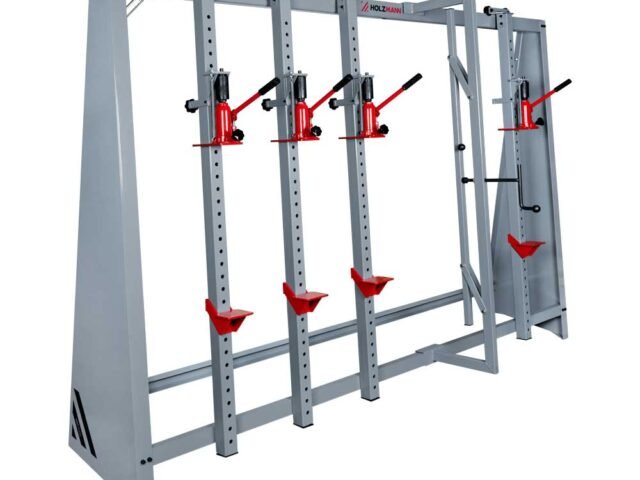
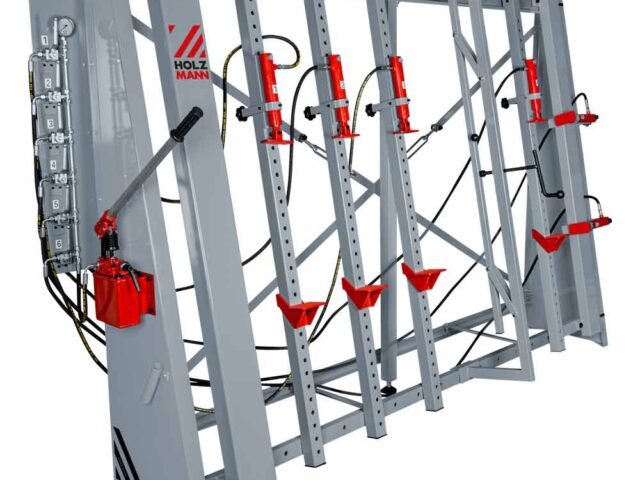
What a panel glue press actually solves
A panel glue press fixes two problems at once, which is why sash clamps on trestles are not an equivalent. The vertical units close the glue line so the joints have no gaps, and the frame holds the assembly flat so the panel does not bow while the adhesive cures. On the HOLZMANN VSTR3000 that second job is done explicitly: two of its six pressing units push horizontally against the panel face rather than down on the edges, keeping the boards in one plane while the four vertical units close the joints. Both presses on this page are HOLZMANN VST-frame machines for solid-wood panel work.
Choosing between the VST3000 and the VSTR3000
The choice is between simplicity and control. The VST3000 is mechanical: four pressing units, each rated 2.5 t – the higher force per unit of the two – applied by hand with no hydraulic pack, no valves and no electrical connection anywhere in the specification. Nothing on a VST3000 can leak or lose pressure overnight, and nothing needs a power point. The VSTR3000 is the production machine: six units at 2 t each, two of them horizontal, all worked from one control point, with two stepless hydraulic cylinders holding pressure rather than relying on the operator’s arm. Its frame weighs 325 kg against 220 kg, and that extra mass is what keeps a heavily loaded press from flexing.
Which one suits your volume
Glue-ups per week decide it more than panel size. A joinery shop that glues a few panels a day gets everything it needs from the VST3000 and avoids maintaining hydraulics. A shop gluing panels continuously benefits from the VSTR3000, because setting six units from one control point instead of tightening four by hand shortens every cycle, and the hydraulic hold keeps pressure constant through the whole cure.
Power supply, floor space and workshop conditions
Power supply is not a constraint on the VST3000, which has no electrical connection in its data at all, and the VSTR3000’s hydraulics are the only services to plan for. Floor space is the real requirement. Allow full access along both long sides of the press for loading boards and clearing squeeze-out, and remember that panels have to be carried in and stacked somewhere while they cure – the staging area usually needs more floor than the press. Extraction is not a factor at the press itself, but glue presses live badly in cold, damp corners: adhesive cure times depend on shop temperature, so site the press in the heated part of the workshop.
Consumables, tooling and what drives the quoted price
Budget adhesive, applicators and protective strips separately – a glue press is quoted as a frame, not as a kit. What moves the price between these two machines is configuration rather than brand: the number of pressing units, whether pressure is applied mechanically or hydraulically with central control, the mass of the frame, and then delivery to your site and installation. Ask for both presses to be quoted together if your volume sits near the boundary; the difference in working method is easier to judge against two figures.
როგორ ავირჩიოთ
- Four pressing units or six
- Four vertical units on the VST3000 suit occasional glue-ups. Six units on the VSTR3000, four vertical and two horizontal, give more even closure along a longer panel.
- Force per unit: 2.5 t or 2 t
- The VST3000 applies the higher force per unit at 2.5 t; the VSTR3000 applies 2 t per unit but across six units and holds it hydraulically.
- Mechanical or hydraulic pressure
- Mechanical (VST3000) means nothing to leak, service or plug in. Hydraulic (VSTR3000) means two stepless cylinders hold pressure steady through the whole cure.
- Horizontal flattening units
- Only the VSTR3000 has them - two of its six units press horizontally to hold the boards in one plane. Choose it if panels tend to step or bow at the joints.
- Central control of all units
- The VSTR3000 works all six units from one control point, which shortens the cycle. The VST3000 is set unit by unit, which is fine at low volume.
- Frame mass: 220 kg or 325 kg
- 325 kg of braced frame on the VSTR3000 resists flexing under a full load; 220 kg on the VST3000 is lighter to site and needs less floor reinforcement.
- Glue-ups per week
- A few panels a day is VST3000 territory. Continuous panel production justifies the VSTR3000, where the time saved per cycle is what pays for the machine.