ლენტური ხერხი
A bandsaw cuts curves, resaws boards on the flat and breaks down stock far deeper than a table saw can reach, using a continuous blade running over two wheels. This category covers 11 HOLZMANN (Austria) bandsaws, from the 16 kg benchtop HBS230ECO cutting 90 mm from an ordinary 230 V socket up to the 416 kg HBS700 resaw taking 430 mm on 400 V three-phase power. Cutting height at 90 degrees, throat depth and the blade widths a machine accepts are the three numbers that separate the models. Every bandsaw here is supplied by quotation.
განახლდა
ნაპოვნი დანადგარები
-
HOLZMANN
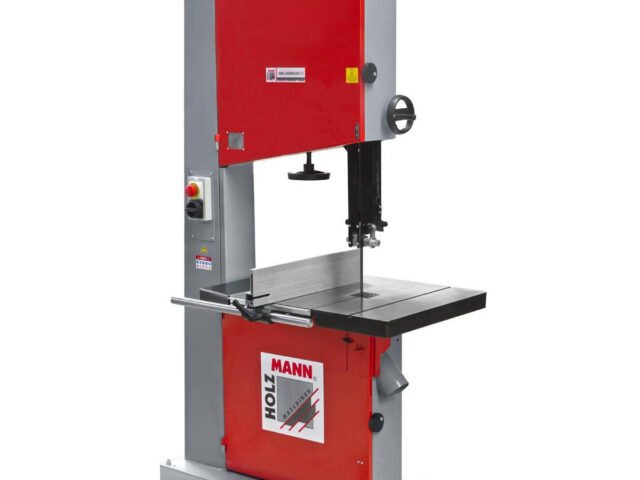
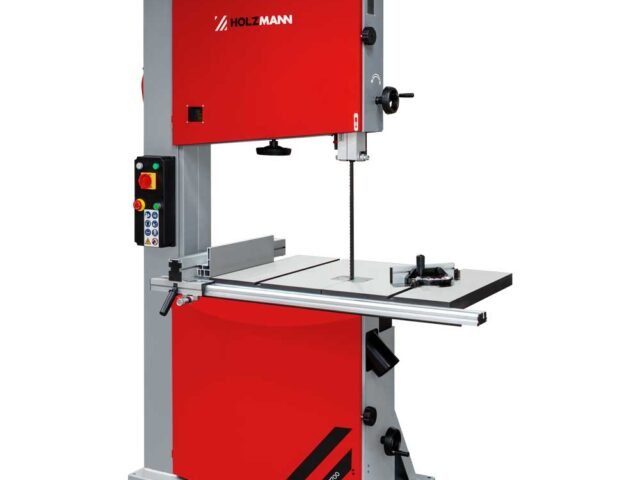
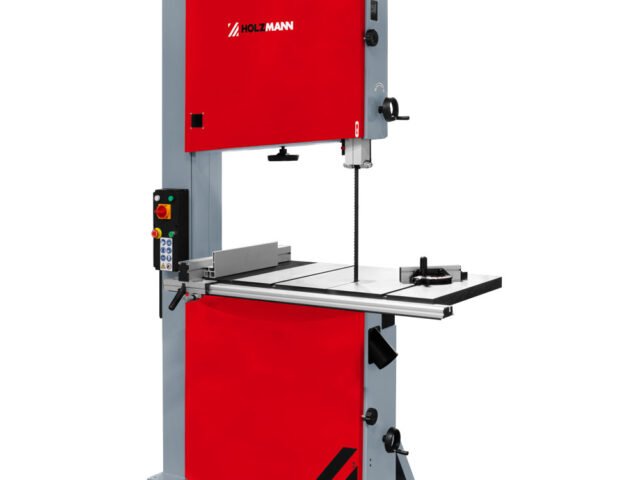
HOLZMANN HBS600DELUX Wood Bandsaw – 600 mm Flywheels, 370 mm Cutting Height
HBS600DELUX- Working width
- 580 mm
- Motor power
- 6 kW
- Voltage
- 400V
ფასი მოთხოვნით ფასის მოთხოვნა -
HOLZMANN
HOLZMANN HBS700 Wood Bandsaw – 430 mm Cutting Height
HBS700- Working width
- 440 mm
- Motor power
- 5.6 kW
- Voltage
- 400V
ფასი მოთხოვნით ფასის მოთხოვნა -
HOLZMANN
HOLZMANN HBS800 Wood Bandsaw – 800 mm Throat, 470 mm Cut Height
HBS800- Working width
- 640 mm
- Motor power
- 7.7 kW
- Voltage
- 400V
ფასი მოთხოვნით ფასის მოთხოვნა
Cutting height at 90 degrees is the first filter
Cutting height decides which bandsaw is even a candidate, and the range here runs from 90 mm to 470 mm. The HBS230ECO and HBS230HQ both cut 90 mm, which suits craft work, small curved parts and thin resawing. The HBS245HQ reaches 152 mm and the HBS300J 165 mm, enough for most furniture stock. From the HBS400 at 220 mm through the HBS470PROFI at 285 mm, HBS610 at 300 mm and HBS600DELUX at 370 mm, the machines become resaws; the HBS700 at 430 mm and HBS800 at 470 mm are for converting slabs and heavy timber. Buy the height you will need in two years, because it cannot be added later.
Throat depth sets how wide a piece can pass
Throat depth – the distance from blade to frame – limits the width of a panel that can be pushed past the blade, and it climbs with the wheel size: 228 mm on the HBS230HQ, 245 mm on the HBS245HQ, 305 mm on the HBS300J, 380 mm on the HBS400 and 700 mm on the HBS700. The HBS610 quotes 545 mm of cutting width at its parallel fence. A workshop cutting curves in wide panels needs throat depth even when cutting height is modest.
Single-phase or three-phase
Supply voltage rules out models before capacity does. The HBS230ECO (350 W), HBS230HQ (300 W), HBS245HQ (375 W) and HBS300J all run on 230 V single-phase, so any workshop with a normal socket can use them. The HBS450 is the crossover machine, ordered as either 230 V single-phase or 400 V three-phase. The HBS600DELUX, HBS700 and HBS800 are 400 V machines only, drawing 4000 W, 4000 W S1 and 5500 W S1 respectively – a three-phase installation is a precondition, not an option.
Band speed and blade width
Band speed and blade width are what turn a bandsaw into either a curve saw or a resaw. Narrow blades follow tight radii; wide blades run straight and resist wander in deep cuts, which is why the HBS700 and HBS800 accept bands up to 50 mm. Two speeds help where species vary: the HBS300J offers 360 and 720 m/min, the HBS450 400 and 900 m/min, the HBS470PROFI 380 and 820 m/min. The HBS600DELUX runs a single 1500 m/min band, the fastest published in the HBS range, for clean production cutting.
Floor space, weight and extraction
Weight tells you what the floor and the doorway must take: 16 kg for the HBS230ECO, 78 kg for the HBS300J, 127 kg for the HBS400, 162 kg for the HBS470PROFI, 300 kg for the HBS610 and 416 kg for the HBS700. Benchtop models need no floor space at all. Every bandsaw needs clear run-off on all sides for the length of stock being cut, and every one needs extraction: a bandsaw throws fine dust below the table, so connect the machine to a chip extractor sized for its port rather than relying on a workshop vacuum.
What separates the cheap end from the expensive end
Beyond capacity, the money goes into rigidity and blade control – cast-iron flywheels, a ground cast-iron table such as the T-slot table on the HBS600DELUX, closed sheet-steel bodies as on the HBS610, tilting tables like the -10 to +45 degree table of the HBS470PROFI, and guides that hold a wide band straight under load. Blades are a consumable, priced by length and width, and should be budgeted from the start in the widths the work actually requires.
როგორ ავირჩიოთ
- Cutting height up to 90 mm
- HBS230ECO and HBS230HQ. Benchtop saws for craft parts, small curves and thin resawing; 16 kg and 20 kg respectively, so no floor space is used.
- Cutting height 150-170 mm
- HBS245HQ at 152 mm or HBS300J at 165 mm. This is the band that covers ordinary furniture stock while still running from a 230 V socket.
- Cutting height 220-300 mm
- HBS400 (220 mm), HBS470PROFI (285 mm) or HBS610 (300 mm). Real resawing capacity for a joinery shop, with 127-300 kg of machine to stand on the floor.
- Cutting height 370 mm and above
- HBS600DELUX (370 mm), HBS700 (430 mm) or HBS800 (470 mm). Slab and heavy-timber conversion; all three are 400 V three-phase machines.
- Only 230 V single-phase available
- HBS230ECO, HBS230HQ, HBS245HQ and HBS300J are single-phase machines, and the HBS450 can be ordered as 230 V. Everything above the HBS450 requires a three-phase installation.
- Two band speeds needed for mixed species
- HBS300J (360/720 m/min), HBS450 (400/900 m/min) or HBS470PROFI (380/820 m/min). Slow for dense hardwood, fast for a cleaner finish in softwood.
- Wide blades for straight deep cuts
- HBS700 and HBS800 take bands up to 50 mm wide; the HBS610 takes 8-32 mm and the HBS600DELUX 10-35 mm. Wide bands resist wander in resawing; narrow bands are for curves.
- Throat depth for wide workpieces
- 228 mm (HBS230HQ) to 700 mm (HBS700), with 545 mm of fence cutting width on the HBS610. Check throat depth separately from cutting height if you cut curves in wide panels.