
კარის კასრის CNC შემკრები
A CNC door frame assembly machine cuts and machines door casing stock and joins it into a finished frame - the part that is fixed into the wall opening, not the leaf or its hardware. This category holds 1 machine, from NETMAK: the NKM 240 CNC Kapi Kasasi Birlestirme Makinasi, which saws and mills frame stock 100 to 320 mm wide and up to 50 mm thick with a 3 kW milling spindle at 6000 rpm, and is rated at one single frame every 20 seconds, one double frame every 28, and 150 frames per 8-hour shift. Supplied by quotation and configured to the casing profiles you build.
ნაპოვნი დანადგარები
-
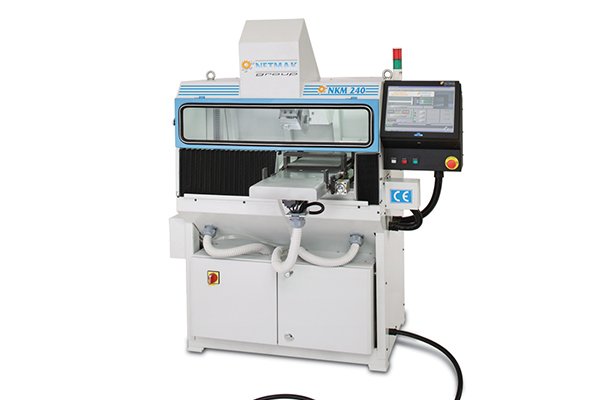 NETMAK
NETMAK NKM 240 CNC Door Frame Assembly Machine
NKM 240 CNC Kapi Kasasi Birlestirme Makinasi- ძრავის სიმძლავრე
- 2.2 kW
- წონა
- 420 kg
ფასი მოთხოვნით
What a CNC door frame assembly machine makes
A CNC door frame assembly machine makes the frame, not the door. The NETMAK NKM 240 CNC saws casing stock to length and angle, mills the corner joint and assembles the pieces into a complete frame in one automatic cycle; the leaf, the lock, the hinges and the finish are all separate operations on separate machines. Georgian door plants that currently cut casings on a crosscut saw and rout the joints against a hand-made jig are replacing two benches, a jig set and a lot of rework with the NKM 240 CNC.
How to size the machine to your output
Output is the number that decides this purchase. NETMAK rates the NKM 240 CNC at one single frame every 20 seconds, one double frame every 28 seconds, and 150 frames per 8-hour shift. A workshop assembling 30 to 40 doors a day uses roughly a quarter of that capacity, which still makes sense when the alternative is two people on a jig, but the NKM 240 CNC is properly loaded in a plant that runs above about 100 frames a day. If your order book is seasonal, size the machine to your peak week rather than your annual average, because the frame line is what holds up door delivery.
Check your casing profile before anything else
Casing capacity, not cycle time, is the hard limit on the NKM 240 CNC. The machine works frame stock 100 to 320 mm wide and up to 50 mm thick. Measure the widest casing you actually sell – wide-wall and telescopic casings are the ones that catch people out – and confirm it against that 100 to 320 mm window before the specification goes any further.
Power supply, floor space and extraction
Power, space and chip removal all have to be settled before the machine arrives. A 3 kW milling spindle at 6000 rpm plus the feed and clamping drives is an industrial load rather than something you plug into a wall socket, so the supply variant for the NKM 240 CNC should be written on the quotation and checked against what your building actually has. Milling dry casing stock throws a lot of chip, so plan an extraction drop at the spindle and add the machine to your extractor’s total airflow demand rather than assuming the existing system will absorb it. For floor space, allow the machine footprint plus clear infeed and outfeed the length of your longest casing, with room for an operator to stand and stack at each end.
Tooling and consumables to budget separately
Tooling is a separate line on the quotation. Saw blades and profile milling cutters for the NKM 240 CNC are consumables matched to the casing profiles you produce, so budget a working set per profile plus spares and a sharpening arrangement. Clamping and support parts specific to unusual frame sections are also quoted separately.
What drives the price of a door frame assembly machine
Price on a machine of this class is driven by configuration rather than by a list figure: the capacity and options specified, the tooling package for your profiles, delivery to your site, installation and commissioning, and operator training. Ask for those items priced separately on the quotation so you can see what is machine and what is project cost.
როგორ ავირჩიოთ
-
Casing width 100-320 mm
Measure the widest casing profile you sell, including wide-wall and telescopic sections. Anything above 320 mm falls outside the NKM 240 CNC and has to stay on the manual bench.
-
Casing thickness up to 50 mm
Standard door casing stock sits comfortably inside 50 mm. Check thick hardwood or fire-rated casings against this limit before specifying.
-
Output above roughly 100 frames a day
The NKM 240 CNC is rated at 150 frames per 8-hour shift. Above about 100 frames a day the machine is properly loaded; below 40 a day it is bought for consistency and labour saving rather than capacity.
-
Single frames versus double frames
Cycle time is 20 seconds for a single frame and 28 for a double. If your mix is mostly double frames, work your daily capacity from the 28-second figure, not the headline 20.
-
3 kW milling spindle at 6000 rpm
The spindle handles the joint milling as well as the sizing, so profile cutters must be specified for it. Confirm the cutter interface with the tooling list on the quotation.
-
Electrical supply
A 3 kW spindle plus feed and clamping drives is an industrial load. Have the exact supply variant of the NKM 240 CNC written on the quotation and checked against your building before layout is fixed.
-
Chip extraction capacity
Sawing and milling dry casing stock produces continuous chip. Add the NKM 240 CNC to your extractor's total airflow demand rather than assuming spare capacity exists.
-
Infeed and outfeed space
Allow the machine footprint plus clear length equal to your longest casing at both ends, with standing and stacking room for one operator.