
ლობზიკის ჩარხი
A scroll saw cuts tight internal curves, fretwork, marquetry and inlay with a fine reciprocating blade that can be threaded through a drilled hole, work no band saw or jigsaw will do cleanly. This category currently holds 1 machine, the HOLZMANN DKS21PRO, with a 406 mm throat, a 320 x 482 mm table tilting to 45 degrees and a 120 W motor running steplessly from 500 to 1700 min-1. The DKS21PRO is supplied by quotation.
- HOLZMANNფილტრის მოხსნა
- მასივიფილტრის მოხსნა
- პლასტიკიფილტრის მოხსნა
- 230Vფილტრის მოხსნა
- 400Vფილტრის მოხსნა
- ყველას გასუფთავება
ნაპოვნი დანადგარები
-
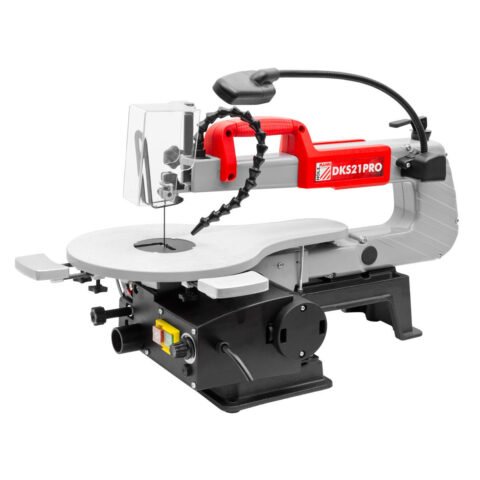
 ლობზიკის ჩარხი
HOLZMANN DKS21PRO ელექტრო ლობზიკი (406 mm ყელი, 500-1700 min-1)
- ძრავის სიმძლავრე
- 0.12 kW
- ძაბვა
- 230V
- მაგიდის ზომა
- 320 x 482 mm
ფასი მოთხოვნით
How to choose a scroll saw
Throat depth decides what a scroll saw can reach, so start there. The throat is the distance from the blade to the arm at the back of the machine, and it sets the largest panel you can turn inside the saw: the HOLZMANN DKS21PRO gives 406 mm, which takes a workpiece roughly 800 mm wide if the cut runs down the middle of it and much more if the cutting is along one edge. Cutting height is the second limit: the DKS21PRO cuts 57 mm at 90 degrees and 27 mm at 45 degrees, so it is a machine for panels, boards and stacked thin stock rather than for sawing blanks out of thick timber.
Why stepless speed matters more than motor size
Blade speed, not motor power, is what a scroll saw is judged on. The DKS21PRO runs steplessly from 500 to 1700 min-1 on a 120 W motor, and the low end of that range is the point: hardwood, acrylic and thin metal burn or melt at high stroke rates, while softwood and plywood cut faster and cleaner near the top of the range. A saw locked to one speed forces you to change blades to compensate. Standard 127 mm fret blades keep the consumable cheap and easy to source.
Table tilt
A tilting table is what lets a scroll saw cut bevelled edges and inlay pockets that drop in tightly. The 320 x 482 mm table of the DKS21PRO tilts to 45 degrees, and that same tilt is why cutting height drops from 57 mm at 90 degrees to 27 mm at 45 degrees – plan the thickness of bevelled parts around the 27 mm figure, not the 57 mm one.
Power supply
Power supply is a non-issue with a scroll saw. At 120 W the DKS21PRO draws less than most hand tools, so it runs from an ordinary single-phase socket with no dedicated installation, no starter and no three-phase connection – unlike the spindle moulders and panel saws elsewhere in the woodworking range. Confirm the voltage on your quotation.
Bench space and dust
A scroll saw needs a solid bench more than it needs floor area. Mount the DKS21PRO on a bench heavy enough not to transmit the reciprocating motion, at a height that lets you sit at the machine, because scroll work is done seated over hours rather than standing in short bursts. Dust volume is small but the dust is fine and it lands directly in front of the operator, so plan a small mobile extractor or an ambient air cleaner in the same corner rather than relying on the blower alone.
What you budget separately
Blades are the real running cost of a scroll saw, not the machine. Keep a stock of 127 mm fret blades in several tooth counts: coarse skip-tooth blades for softwood and plywood, fine blades for hardwood and inlay, and spiral blades for cutting in any direction without turning the workpiece. Budget also for a drill for starter holes in internal cut-outs, a bench and a task light directly over the blade.
Where a scroll saw stops and another machine starts
A scroll saw handles fine internal work only. For curves cut from the outside of thicker stock a band saw is the correct machine, and for shaped repeat parts in production a CNC router replaces the scroll saw entirely. Choose the DKS21PRO for one-off decorative work, sample making, restoration and pierced internal cut-outs, and request a quote with a description of the material thickness you work in.
როგორ ავირჩიოთ
-
Throat depth 406 mm
Sets the largest panel that can be turned inside the saw - about 800 mm wide when the cut runs down the centre of the piece.
-
Cutting height 57 mm at 90 degrees
Suits panels, boards and stacked thin stock; sawing blanks from thick timber belongs on a band saw instead.
-
Cutting height 27 mm at 45 degrees
Plan bevelled and inlay work around 27 mm, since tilting the table costs you more than half the cutting height.
-
Stepless 500-1700 min-1
Run the low end for hardwood, acrylic and thin metal that burn or melt; run the top end for softwood and plywood.
-
Table 320 x 482 mm, tilts to 45 degrees
Enough support for framed panels and marquetry; the tilt covers bevelled edges and drop-in inlay pockets.
-
120 W motor
Runs from an ordinary single-phase socket - no starter, no dedicated circuit, no three-phase installation.
-
Standard 127 mm fret blades
Keeps the consumable cheap and widely available; stock coarse, fine and spiral blades rather than one type.