
დახრილღერძიანი საფრეზი
A tilting spindle moulder shapes mouldings, rebates, tenons and raised panels with a spindle that swings out of vertical, so an angled or undercut profile is cut by tilting the tool instead of jigging the workpiece. This category holds 1 machine, from NETMAK: the FR 2000Y, whose spindle tilts from -5 to +45 degrees and runs cutters up to 300 mm at 3200, 4200, 6000 or 8000 rpm on a 5.5 kW motor. Tilting spindle moulders are supplied on quotation, with cutters, power feed and extraction specified against the profiles your workshop actually cuts.
ნაპოვნი დანადგარები
-
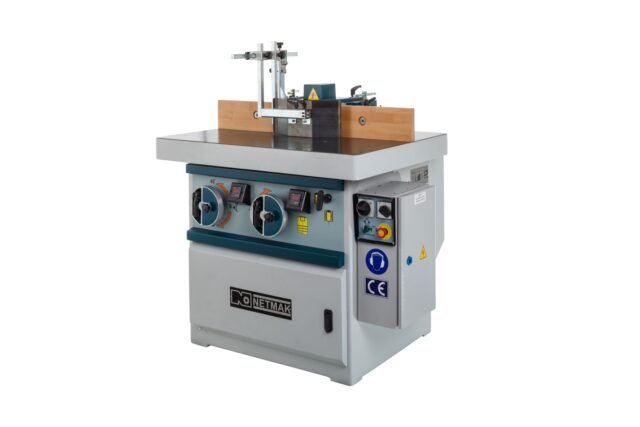
 დახრილღერძიანი საფრეზი
NETMAK FR 2000Y Tilting Spindle Moulder
- ძრავის სიმძლავრე
- 5.5 kW
- მაგიდის ზომა
- 1050 x 800 mm
- მაგიდის სიმაღლე
- 900 mm
ფასი მოთხოვნით
A tilting spindle moulder earns its place when the profile is angled
Tilt is the whole reason to pay for this class of machine. A fixed vertical spindle moulder cuts exactly the shape ground into the cutter, so every bevelled glazing bead, sloped panel field, undercut lip and angled stair component needs either a dedicated cutter or a tilting jig. A tilting spindle moulder swings the spindle instead: the NETMAK FR 2000Y moves from -5 to +45 degrees, a 50 degree range, so one cutter covers a family of angled profiles and the workpiece stays flat on the table where it can be fed safely. A workshop that only ever cuts vertical profiles does not need tilt and should specify a fixed spindle moulder instead.
Capacity on a tilting spindle moulder is set by cutter diameter and spindle stroke
Cutter diameter is the first figure to check. The FR 2000Y accepts cutters up to 300 mm, gives 170 mm of vertical spindle travel and a usable spindle height of 140-150 mm, so a tall door or panel-raising profile is cut in one pass rather than in two overlapping passes that leave a witness line. The four spindle speeds of 3200, 4200, 6000 and 8000 rpm exist so that rim speed can be matched to cutter diameter: a 300 mm head belongs at the bottom of that range, a small rebate cutter at the top. The table measures 1050 x 800 mm at a 900 mm working height, and the machine’s ring inserts cover table flange diameters of 115, 170, 220, 270 and 345 mm.
Power supply, floor space and extraction for a tilting spindle moulder
Settle the electrical supply before the machine is on the floor. The FR 2000Y is driven by a single 7.5 HP / 5.5 kW motor, and the supply voltage the machine will be configured for should be confirmed at quotation rather than assumed, because a spindle motor of that size is normally a three-phase specification. Floor space is the second constraint: the FR 2000Y occupies 1050 x 1200 x 1400 mm and weighs 490 kg, and long mouldings need clear infeed and outfeed on both sides of the table, not merely the machine footprint. A tilting spindle moulder throws a heavy volume of chips, so a chip extractor sized for the machine has to be connected before the first cut. Extraction is not included with the FR 2000Y.
Budget the tooling for a tilting spindle moulder separately
Tooling routinely costs a serious fraction of a moulder purchase. Cutters, a power feed unit, extraction ducting and the electrical connection are not supplied with the FR 2000Y. A power feed is the accessory that changes results most: it holds the workpiece down and against the fence at a constant rate, which on a tilted spindle keeps the profile identical from the first metre of a batch to the last and keeps hands away from a large cutter running at an angle.
What separates the cheap end of the moulder range from the expensive end
Mass, tilt accuracy and setting repeatability are what the money buys. A light fixed moulder is cheap because it has no tilt mechanism, no digital indication and less iron under the spindle, and it pays for that in vibration and settings re-found by trial on every batch. The FR 2000Y answers with a monoblock steel body, a cover protection circuit, an electromechanical brake, a guard for curved work and digital height and angle indication.
როგორ ავირჩიოთ
-
Tilt range -5 to +45 degrees
Specify a tilting spindle moulder only if bevelled, undercut or angled profiles are regular work; a 50 degree range lets one straight cutter replace a shelf of angled profile cutters.
-
Cutter diameter up to 300 mm
Check the largest head you intend to run before ordering tooling. Big panel-raising and door heads need the full 300 mm capacity and the lowest of the four speeds.
-
Four speeds: 3200, 4200, 6000, 8000 rpm
Match speed to cutter diameter, not to the timber. Large heads run at 3200-4200 rpm; small rebate and bead cutters want 6000-8000 rpm for a clean finish.
-
Spindle stroke 170 mm, usable height 140-150 mm
Tall profiles in one pass need this stroke. If your deepest profile is under 100 mm, a smaller fixed moulder will cover the work.
-
Digital height and angle indication
Essential where the same profile is repeated across batches: the tilt angle is recorded as a number instead of being re-found by trial on scrap.
-
490 kg, 1050 x 1200 x 1400 mm
Plan a level floor plus clear infeed and outfeed for the longest moulding you run; the footprint alone is not the space the machine needs.
-
Power feed unit
Budget a feeder with the machine for any production run. On a tilted spindle a feeder is the main determinant of consistency and of operator safety.
-
Extraction connection
A chip extractor sized for the moulder must be connected before commissioning; extraction and ducting are not included with the machine.